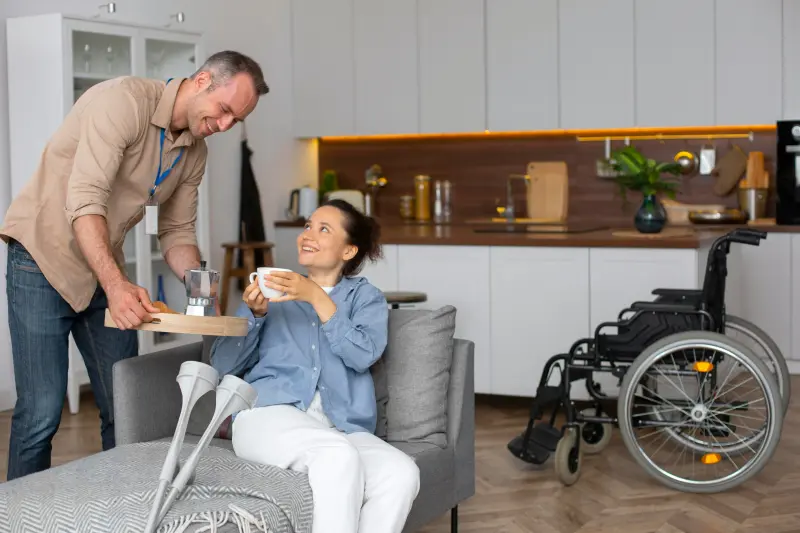

Supported accommodation is ideal for people who need a little extra help, but who want to stay independent. Whether you’re a disabled adult, struggling with an unsafe living situation, a young person ageing out of the care system, or an older person, supported living could help.
In this guide, we’ll briefly explain what supported living is, and talk about when it might be appropriate to make the move. We’ll also cover the alternatives to supported living, and how long you can stay in supported accommodation.
If you’re looking for supported accommodation, Find Your Room is here to make it easy. Use our website or app to find your ideal property.
Simply use our supported living search, enter your preferred location, and filter by residency type, care type, facilities, and CQC rating. Make sure to look for vacant properties, too, so you know that they’ll have availability for you!
What’s sheltered accommodation?
Supported living, also known as sheltered accommodation, supported accommodation, assisted living, or independent living, is a mixture of housing and personalised support.
Individuals in supported accommodation may share a house or flat with other residents, or they may have their own flat or bungalow in a larger independent living development. Staff are usually available to provide care, assist with housekeeping, teach life skills, and offer help in an emergency.
Find out more about supported living in England.
When should I move to supported accommodation?
Choosing when to move to supported living is a very personal decision. You don’t have to make a decision simply because you’re a certain age, or you’ve received a new diagnosis. Instead, you should base your decision on how well you’re coping in your existing home.
Sometimes, it’s an easy decision to make – for example, if you’re homeless or in an unsafe living situation. Other times, though, it can be tricky. You might not feel ready to move to supported living yet, especially if you’re living in your own home or with family.
However, it’s good to be prepared for the future. We’ve put together a list of signs that suggest you may want to think about supported accommodation.
Signs that it’s time to consider supported living:
You struggle to manage your own needs: Do you find it difficult to wash or dress yourself, take your medication, or prepare meals? Some people will find these activities difficult because of mobility issues, whereas others might have memory problems or learning disabilities that make it hard for them to manage. In a supported living scheme, staff members can help you with your care needs.
You struggle to manage taking care of your own home: If you currently live in your own home, you may find it hard to take care of the housekeeping and gardening – especially as you age, or if you’re ill or injured. Some people are happy to stay in their home and hire gardeners, cleaners, and carers. However, others would prefer to move to a new property that’s smaller, easier to care for and more accessible.
You currently live in a care or nursing home but don’t need a high level of support: Some people might live in a care home but would be able to manage living elsewhere. You might have been discharged from hospital to a care home, or moved there many years ago and would now be able to thrive in a supported living environment. If you don’t need 24-hour care, and you can manage some of your daily activities yourself, supported accommodation might help you live a more independent life.
You often feel lonely or isolated: Do you find it hard to get out and about, and struggle to see friends or family? Living alone can be particularly isolating for older people and those with disabilities. In supported accommodation, you’d be surrounded by other residents and have the opportunity to socialise – while still being able to go back to your own room or flat if you wanted to be alone.
Your family carers are struggling to support you: You may currently be supported by family members. However, as they age and your care needs increase, they may find it harder to look after you. In a supported living scheme, care workers can handle your needs – and, of course, you can continue to spend time with your family.
Your current living situation isn’t safe: Your home life might be unsafe for several reasons. For example, you might live with someone who is violent or coercive, or the property itself might be dangerous. In either of those situations, you may need to leave urgently and find emergency accommodation elsewhere in the UK. Supported living can help you get back on your feet.
You’re homeless, or at risk of becoming homeless: If you don’t currently have a home, or know that you will be homeless within weeks, supported living might be a good solution.
A health or social care professional has identified that supported living might be a good choice for you: You may have had a needs assessment from your local authority, or been assessed as part of the hospital discharge process. If the discharge team, social worker, or occupational therapist believes that supported living is a good idea for you, you should consider it. Supported accommodation can help you manage your needs and learn life skills, while still letting you live independently.
If any of these signs apply to you, it might be time to consider moving to supported living.
Remember, it may take time to find a suitable supported living property and arrange to move there. If you think that you, or a loved one, would benefit from supported living, it’s best to make enquiries early.
How long can you stay in supported accommodation?
How long you can stay in a supported living scheme will depend on your circumstances, as well as the organisation’s policies. You may be able to live there indefinitely, or you might be there for a few months or years, depending on your needs.
Some supported accommodation is designed for people to live there long-term.
If you have a disability or are looking for sheltered housing for older people, you can often stay in supported living for the rest of your life – unless care needs increase and you need a care home.
Some supported living schemes support residents for a short time.
Supported accommodation might house people under 25, people who have recently been homeless, people coming from unsafe living situations, or people who are struggling with addiction. These properties are often designed to help residents get back on their feet, teach them some life skills, and help them stay healthy.
After a few months or years, residents are expected to have the skills to live independently in their own homes.
Sometimes, individuals may be asked to leave a supported living property before they feel ready. This might be because they’ve aged out of a scheme, their care needs have increased, the scheme is closing down, or they have broken some of the scheme’s rules. If you’re asked to leave a supported living programme, the staff team and your social worker should be able to help you decide on your next steps.
The alternatives to supported living
Supported living isn’t the right choice for everyone. You might not want to move, or the staff team might not think that you would benefit from the support on offer at their scheme. Fortunately, there are alternative options.
If you aren’t assessed as needing help from a supported living scheme, you may be able to live independently in a home of your own. This might be your existing home, or you may need to move somewhere more accessible, and perhaps access support from relatives or carers. If your living situation isn’t safe or you need help finding housing, contact the housing team at your local council for support and advice.
If you need more help than supported living can offer, you could consider a care or nursing home. Care and support will be available throughout the day and night, and the property should be fully accessible. You’ll be able to spend time with other residents, and the home will provide meals and housekeeping.
If you want to stay at home but need help, you could consider home care. You could hire a care agency or an individual caregiver to visit and provide help with personal care, housekeeping, and meal preparation.
Finding supported living accommodation
Just like finding the right care home, finding the right supported living solution can be tricky. You can search online for “supported living near me”, but that doesn’t mean you’ll always find appropriate properties. You may need to contact several organisations before you find somewhere that has availability – which adds stress to an already emotional search.
However, Find Your Room can help. Our supported living search lets you look for supported accommodation by location, and gives you the chance to filter by availability – so you’ll know that the property you contact has room for you.